Montessori Toys vs Regular Toys: The Battle for the Playroom
Are wooden, passive toys actually better for brain development than flashing plastic lights? We break down the science, the cost, and the fun factor.
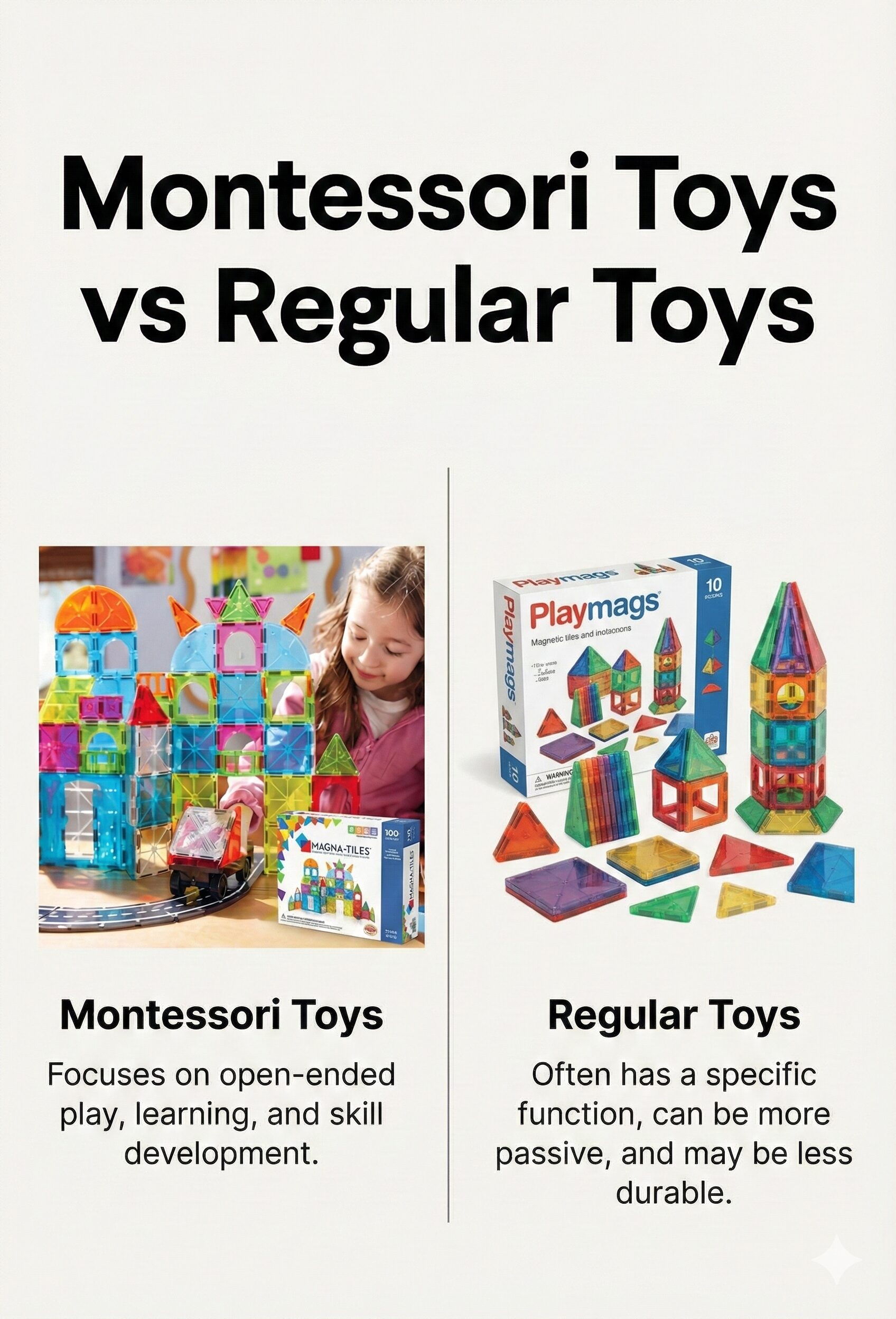
Walk into a modern nursery, and you will likely see a stark divide in design philosophy. On one side, you have the “beige aesthetic”—wooden rattles, muted colors, and simple shapes inspired by the Montessori method. On the other, you have the vibrant chaos of the toy aisle: flashing lights, singing cartoons, and plastic battery-operated gadgets.
The debate of Montessori toys vs regular toys is not just about aesthetics; it is a fundamental question about child development. Does a child learn more from a toy that does everything for them, or a toy that requires them to do everything? While wooden toys vs plastic toys is a common comparison, the Montessori distinction goes deeper than just materials.
In this comprehensive guide, we will dissect the differences between these two play philosophies. We’ll explore which is better for cognitive growth, durability, and your wallet, helping you curate the perfect playroom for your child.
At a Glance: The Key Differences
Before we dive deep, here is a quick snapshot of how Montessori tools differ from mainstream commercial toys.
| Feature | Montessori Toys | Regular Toys |
|---|---|---|
| Primary Material | Wood, Metal, Glass, Fabric (Natural) | Plastic, Synthetic Fibers |
| Child’s Role | Active (Child manipulates the toy) | Passive (Toy entertains the child) |
| Sensory Input | Grounded, realistic weight & texture | High stimulation (Lights, Sounds) |
| Purpose | Skill isolation & mastery | Entertainment & distraction |
| Realism | Based on reality (Tools, Animals) | Fantasy (Cartoons, Talking cars) |
The Core Philosophy: “Active Toy” vs. “Active Child”
The biggest differentiator in the Montessori toys vs regular toys debate is the level of engagement required from the child. Maria Montessori, the Italian physician who founded the method, believed that “play is the work of the child.”
Montessori: The Toy is Passive
A Montessori toy is designed to be simple. It does not sing, dance, or flash lights. Because the toy is “passive,” the child must be “active” to interact with it. This fosters intense concentration and benefits of imaginative play because the child determines the outcome. If a child wants a wooden block to be a car, they must make the engine noises and push it.
Regular Toys: The Toy is Active
Many mainstream toys are designed to entertain. You press a button, and the toy recites the alphabet or plays a song. While these can be fun, they often render the child passive. The child becomes an observer rather than a participant. This can limit the depth of play, as the toy dictates the rules of engagement.

Want to start with Montessori? Check out this complete developmental play kit.
Check Price on AmazonCognitive Development and Skill Isolation
How do these toys actually teach your child?
Skill Isolation (Montessori)
Montessori toys are usually designed to teach one single concept at a time. This is called “isolation of quality.” For example, a shape sorter might only focus on fitting a circle into a hole, without confusing the child with neon colors or background music. This helps children master concepts like object permanence or fine motor skills faster because they aren’t distracted.
The “Swiss Army Knife” Approach (Regular)
Regular toys often try to do everything at once. A walker might also have a piano, a telephone, and a light-up screen attached to it. While this seems like “more value for money,” it can lead to sensory overload. The child may bounce from one feature to another without truly mastering any specific skill.
However, regular toys excel in other areas. For instance, high-quality construction sets like Disney LEGO sets or magnetic tiles bridge the gap. In fact, when looking at Picasso Tiles vs Magna-Tiles, we see that some plastic toys offer incredible open-ended play value that rivals traditional wooden blocks.
Reality-Based Play vs. Fantasy Worlds
One of the most controversial aspects of Montessori is its stance on fantasy. Traditional Montessori philosophy discourages fantasy play for children under six, preferring to ground them in the real world to help them understand their environment.
- Montessori Approach: You will see miniature kitchens, cleaning sets, and realistic animal figurines. The goal is to help the child understand the world they live in. A child plays with a “baby” doll to practice caretaking, not to pretend the doll is a flying fairy.
- Regular Toy Approach: Mainstream toys embrace fantasy. This is the world of Disney Princesses, superheroes, and talking animals.
Is fantasy bad? Not necessarily. Understanding what is pretend play is crucial here. While Montessori prefers reality, psychologists agree that fantasy play helps develop empathy and narrative skills. Many parents choose to mix both—using Montessori for skill building and regular toys, like pirate toys or space sets, for creative storytelling.
If your child loves dress-up, you don’t have to ban it to be “Montessori.” Whether it is a Cinderella dress or a generic doctor’s coat, the value lies in the role-playing.

Materials, Durability, and the “Throwaway” Culture
There is a practical side to the Montessori toys vs regular toys comparison: longevity.
The Montessori Aesthetic
Montessori toys are predominantly made from wood, metal, glass, and cotton. They are heavy, tactile, and durable. The weight of a wooden toy gives a child feedback—if they drop it, it makes a loud thud. This teaches cause and effect.
The Plastic Dilemma
Regular toys are often made of lightweight, injection-molded plastic. While cheaper, they break easier. Once a battery-operated toy stops working, it often ends up in a landfill. However, high-quality plastic toys do exist. For example, in the debate of best creative toys, many durable plastic building sets last for generations.
Pros and Cons Breakdown
Let’s summarize the strengths and weaknesses of both categories to help you decide.
Montessori Toys (Pros)
- Encourages Deep Focus: Fewer distractions lead to longer play sessions.
- Develops Fine Motor Skills: precise movements are required.
- Eco-Friendly: Usually made from sustainable wood.
- Aesthetically Pleasing: Looks good in a living room.
- Open-Ended: A wooden stacker can be a tower, a fence, or food.
Montessori Toys (Cons)
- Expensive: High-quality wood costs more than plastic.
- Can Be “Serious”: Lacks the immediate “wow” factor of flashing lights.
- Availability: Harder to find in big-box stores.
- Heavy: Wooden toys can hurt if thrown by an enthusiastic toddler.
Regular Toys (Pros)
- Immediate Engagement: Captures attention instantly.
- Affordable: Accessible at every price point.
- Character Connection: Kids love playing with their favorite TV characters (like Disney Villains or heroes).
- Technological Learning: Some electronic toys teach coding and language.
Regular Toys (Cons)
- Overstimulation: Can lead to fragmented attention spans.
- Passive Play: The toy entertains the child, rather than the child playing.
- Breakable: Cheap plastic mechanisms fail often.
- Battery Dependent: Constant cost and maintenance.
Which is Better for Whom?
Choosing between Montessori and regular toys isn’t a black-and-white decision. It depends on your child’s age and your family’s values.
Best for Babies and Toddlers (0-3 Years): Montessori
At this stage, children are learning the basics of physics and motor control. Simple wooden rattles, object permanence boxes, and stacking rings are superior. They prevent overstimulation and help the child understand how the world works. For this age group, check out the best pretend play toys that bridge the gap between simple manipulation and early imagination.
Best for Preschoolers (3-5 Years): A Mix
As imagination explodes, a strict Montessori approach can feel limiting. While you should keep open-ended construction toys (like blocks), adding “regular” toys like a Barbie dollhouse or Disney dresses for role-play allows them to explore social scenarios and storytelling.
Best for Older Kids (6+ Years): Interest-Led
At this age, the line blurs. LEGO sets, science kits, and even specific themed toys like space toys can be highly educational, even if they aren’t “Montessori” in the traditional sense.

Frequently Asked Questions
Many experts argue yes, particularly for children under 5. Because Montessori toys isolate skills and require active participation, they foster better concentration, problem-solving skills, and cause-and-effect understanding compared to passive, entertainment-focused toys.
Montessori toys are typically made from sustainably sourced solid wood and non-toxic paints rather than mass-produced plastic. The manufacturing process is often more labor-intensive, and the materials are designed to last for generations.
Absolutely. Many families practice “Montessori-ish” parenting. You might use wooden puzzles and practical life tools for skill-building, but still have a basket of fantasy figures or cars for imaginative play. The key is moderation and avoiding clutter.
Strictly speaking, LEGO is a commercial toy. However, many Montessori educators love LEGOs because they are open-ended, promote fine motor skills, and teach spatial awareness. They fit well within a Montessori-inspired home, provided they are organized well.
Final Verdict: The Balance in the Toy Box
In the battle of Montessori toys vs regular toys, there is no single winner that applies to every child at every moment. Montessori toys offer undeniable benefits for focus, sensory development, and independence—especially in the early years. They are investments in your child’s ability to concentrate.
However, regular toys bring color, cultural connection, and pure joy. Denying a child a toy simply because it is plastic or features a cartoon character is not necessary for successful development.
The recommendation? Build the foundation of your playroom with open-ended, Montessori-style materials (blocks, art supplies, realistic tools). Then, sprinkle in high-quality “regular” toys that align with your child’s specific interests, whether that is space, princesses, or pirates. The best toy is ultimately the one that the child engages with deeply.
Ready to revamp your playroom? Browse the best-selling educational toys today.
Explore Toys on Amazon